
The honest dental implant success rate Gurgaon patients can expect tracks international data: ~97% at 5 years, ~93% at 10 years, ~88% at 15–20 years for healthy non-smokers. This dentist-reviewed authority guide explains the real statistics, the causes of the small percentage of failures, and what affects your personal outcome at Muskaan Dentals.
📊 Real Statistics · Peer-Reviewed Data
Dental Implant Success Rate Gurgaon
Honest Numbers — The Real Picture
Across the long-term peer-reviewed literature, the dental implant success rate Gurgaon patients can expect closely tracks international data: ~97% at 5 years, ~93% at 10 years, ~88% at 15–20 years for healthy non-smokers in standard bone. Roughly 2–3% of implants fail in the first 6 months; additional failures accumulate slowly over decades. The numbers are slightly lower for smokers, uncontrolled diabetics, and severe bone-loss cases.
~97%
5-year success
~93%
10-year success
~88%
15-20 year success
2-3%
Early failure
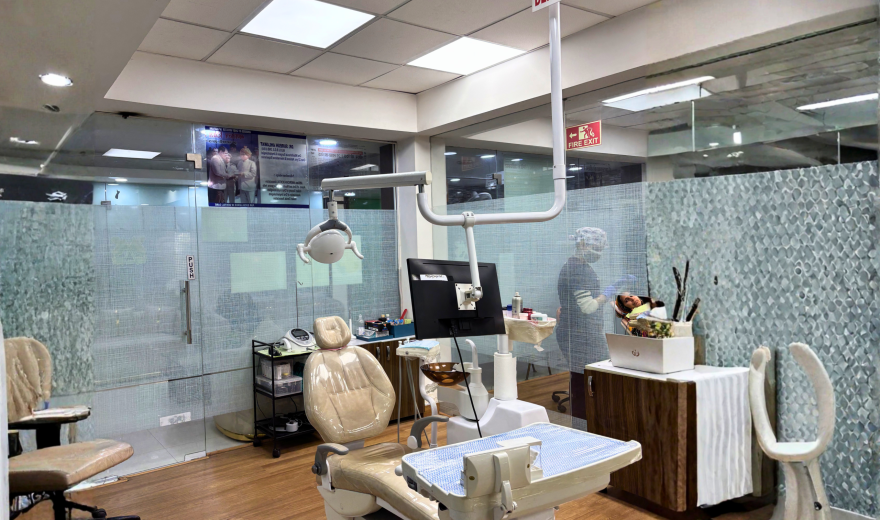
✅ Real clinic photo — already in Media Library (geo-tag with clinic coordinates on upload).
If you are considering a dental implant, one of the most useful questions you can ask is: how often do these actually work, and how often do they fail? The honest answer involves real numbers from peer-reviewed research — not the marketing-friendly “99% success rate” figures some clinics quote. This dentist-reviewed authority guide sets out exactly what the implant success statistics show across 5, 10, 15, and 20 years, what causes the small percentage of failures, what factors affect your specific success rate, and how Muskaan Dentals tracks outcomes honestly.
What Are the Actual Success Rates Over Time?
The most reliable success-rate data comes from large, long-term studies and systematic reviews published in peer-reviewed dental journals — not from individual clinic marketing. Across decades of international research covering tens of thousands of implants placed under standard protocols, the consistent findings are these:
5 YEARS
~96–98% success
Typical figure across major studies for healthy non-smoking patients in standard bone.
10 YEARS
~90–95% success
A small additional percentage of late failures occur, mostly from peri-implantitis.
15–20 YEARS
~85–90% success
Cumulative failures level off; well-maintained implants commonly last several decades.
These ranges hold up across systematic reviews (Pjetursson et al, Buser et al) and large multi-centre cohorts. They represent healthy patients in standard cases; smokers and uncontrolled medical conditions sit at the lower end or below.
Illustration to add — AI-generated
| 📐 SIZE | 780 × 500 px (WebP, max 150KB) |
| 🏷️ FILE | dental-implant-success-rates-chart-illustration.webp |
| 🔤 ALT | Bar chart of dental implant success rates over time: 97 percent at 5 years, 93 percent at 10 years, 88 percent at 15 to 20 years, with 2 to 3 percent early failure rate |
🎨 AI IMAGE PROMPT:
Clean medical infographic on a soft off-white background showing a horizontal bar chart of dental implant success rates over time. Four green-to-amber gradient bars representing four time periods: '5 YEARS - 97%', '10 YEARS - 93%', '15-20 YEARS - 88%', and one red small bar 'EARLY FAILURE - 2-3% (first 6 months)'. Clear percentage labels on each bar. A small footnote below: 'Healthy non-smokers in standard bone, peer-reviewed long-term studies'. Navy #1a1a2e and red #c0392b accents with green-to-amber gradient on success bars. No baked-in paragraph text beyond short labels and percentages. Professional dental-education aesthetic, flat vector chart style.
Clean medical infographic on a soft off-white background showing a horizontal bar chart of dental implant success rates over time. Four green-to-amber gradient bars representing four time periods: '5 YEARS - 97%', '10 YEARS - 93%', '15-20 YEARS - 88%', and one red small bar 'EARLY FAILURE - 2-3% (first 6 months)'. Clear percentage labels on each bar. A small footnote below: 'Healthy non-smokers in standard bone, peer-reviewed long-term studies'. Navy #1a1a2e and red #c0392b accents with green-to-amber gradient on success bars. No baked-in paragraph text beyond short labels and percentages. Professional dental-education aesthetic, flat vector chart style.
How Often Do Implants Fail — and Why?
Asking how often do implants fail is the right question — and the answer separates into two timeframes. Early failures happen in the first 3 to 6 months, when the implant should be fusing with the bone but does not. These account for around 2–3% of all implants and are almost always identifiable within the first few months. Late failures occur after successful integration, accumulating slowly over years and pushing the cumulative failure rate to 5–10% over 10–20 years.
Failed osseointegration
The bone does not fully fuse with the implant in the first months. Usually caused by infection, micromovement, or compromised healing.
Peri-implantitis
Gum disease around an established implant — the single biggest cause of late failure. Largely preventable with hygiene and check-ups.
Occlusal overload
Excessive biting force on the implant, often from teeth grinding, can cause mechanical failure over years.
Patient factors
Heavy smoking, uncontrolled diabetes, and severe bone loss raise failure rates above the average.
What Affects Your Personal Success Rate?
The published ranges are population averages. Your individual success rate depends on five factors that an honest implantologist will discuss openly at your consultation: general health (controlled diabetes, no major cardiac issues), bone quality and quantity at the site (assessed by CBCT), smoking status (heavy smokers face roughly 2x the failure rate), surgeon experience, and your ongoing oral hygiene. Patients with no risk factors typically sit at the top of the published range; those with one or two manageable risks sit closer to the middle; those with multiple uncontrolled risks may sit below.
The point is not to find a number to memorise but to understand which factors you can influence. Quitting smoking around surgery, getting HbA1c into a safe range, and committing to twice-yearly check-ups can meaningfully move you up the success curve.
How Muskaan Dentals Approaches Outcomes
Strong long-term outcomes come from boring fundamentals done consistently: CBCT 3D imaging on every case before surgery, full medical review including HbA1c and medication assessment where relevant, honest case selection (declining or staging cases that carry too much risk for one-visit treatment), and structured post-operative follow-up at 1 week, 1 month, 3 months, 6 months, then annually for life. Dr. Suresh Ahlawat (BDS, MDS, DNB USA) brings 35+ years of implant experience with international training in France, Korea, Europe, China, and Bangkok. All four Gurgaon branches (Sector 43 Sushant Lok, Sector 56, Sector 14, Sector 52 Ardee City) hold NABH accreditation, meaning clinical protocols and infection control are independently audited.
No clinic can promise 100% success — and any clinic that does is being economical with the truth. What a good clinic can promise is best-evidence planning, transparent risk discussion, and committed follow-up if anything does go wrong. That is the framework Muskaan Dentals works within. Implant reliability India data, properly read, supports being optimistic but not complacent: with the right plan and the right aftercare, dental implants are one of the most successful procedures in modern medicine.
Medically reviewed by Dr. Suresh Ahlawat, BDS, MDS, DNB USA — Chief Implantologist, Muskaan Dentals, Gurgaon. This article is for general information and does not replace a clinical consultation.
Frequently Asked Questions
Dental implant success rate in Gurgaon — honest answers backed by long-term research.
What is the actual success rate of dental implants?
Across the international peer-reviewed literature, dental implants in healthy patients show success rates of approximately 96–98% at 5 years, 90–95% at 10 years, and 85–90% at 15–20 years. These figures come from long-term systematic reviews including Pjetursson and colleagues, and large multi-centre studies covering tens of thousands of implants. “Success” means the implant is still in place, functioning normally, and free of significant gum or bone problems. Numbers are slightly lower for smokers, uncontrolled diabetics, and severe bone-loss cases.
How often do implants fail?
Roughly 2–3% of implants fail within the first 3–6 months — these are called early failures, where the implant does not fuse properly with the bone (failed osseointegration). After that initial healing period, additional late failures accumulate slowly over time, reaching a cumulative failure rate of around 5–10% over 10–20 years for the average patient. The single biggest cause of late failure is peri-implantitis (gum disease around the implant), which is largely preventable with good oral hygiene and regular check-ups.
What factors affect dental implant success?
Five factors matter most: (1) general health, particularly diabetes control and any conditions affecting healing; (2) bone quality and quantity at the implant site; (3) smoking, which raises failure rate by roughly two to three times; (4) the experience of the surgeon placing the implant; and (5) ongoing oral hygiene and follow-up after the implant is fitted. None of these is a single make-or-break factor — most patients have one or two minor risk factors that are managed during planning. Dr. Suresh Ahlawat reviews each of these honestly at the consultation.
Are implant success rates the same in India as worldwide?
Yes — implant biology does not change by country. The same surgical principles, materials (titanium implants from manufacturers like Straumann, Nobel Biocare, Osstem), and protocols are used at Muskaan Dentals as in leading clinics worldwide. Indian patients show the same general success rates as those reported in international studies, with the main variation being case selection, surgeon experience, and patient health rather than geography. Implant reliability India statistics largely mirror European and North American data when comparing similar patient groups.
Can a failed implant be replaced?
Yes, in most cases. If an implant fails to integrate in the early months, it is removed, the site is allowed to heal for 2–3 months (sometimes with a small bone graft if needed), and a new implant is placed. Late failures from peri-implantitis are also typically replaceable once the gum disease has been treated. The replacement success rate is slightly lower than the first attempt — around 80–90% — but most patients who experience a failure go on to a successful second implant.
How does Dr. Ahlawat ensure good success rates at Muskaan Dentals?
Three things drive outcomes: thorough planning (CBCT 3D scans on every case, full medical review, honest case selection), surgical care (35+ years of implant experience, international training in France, Korea, Europe, China, and Bangkok, internationally accepted protocols), and structured follow-up (scheduled checks at 1 week, 1 month, 3 months, 6 months, then annually). NABH accreditation at all four Gurgaon branches means the clinical and infection-control standards are independently audited. Cases at higher risk get more conservative plans, not optimistic ones.
Want Your Personal Success Estimate?
Book a Free Consultation in Gurgaon
A CBCT scan, full medical review, and an honest, individual success-rate estimate based on your specific health and case — not a marketing number.
4 branches across Gurgaon · Mon–Sat 10 AM–7 PM · Sunday 11 AM–1 PM
Dr. Suresh Ahlawat · BDS, MDS, DNB USA · 35+ years · NABH · 4.8★ · 1,900+ Reviews
Our Initiatives



For any Queries or assistance please call: +91-94-94-94-7304
MUSKAAN Dentals is 1st NABH ACCREDITED Chain of Speciality dental centers headed by Dr. Suresh Ahlawat BDS, MDS, DNB (USA) having more than 30 Years of National & International experience, Dr. Ahlawat is a Maxillofacial Surgeon Specially trained in Dental Implants in France, Korea, Europe, China and Bangkok etc in various implant systems.
Treatments
Dental Implants
Dental Crowns
Root Canal Treatment
Dental Bridges
Root Canal
Full Mouth Rehabilitation
Clear Aligners
Laser Dentistry
Pediatric Dentistry
Contacts
Address
C-1039, Near Vyapar Kendra, Sushant Lok Phase - 1, Gurgaon, Haryana - 122009
© 2026 Muskaan Dentals Global | All Right Reserved.
Digital Partner: CODEMOTTO