
Dental implants after bone loss are possible in the great majority of cases. Bone grafting, sinus lift, basal implants, and zygomatic implants each offer a route around bone shortages. This dentist-reviewed guide explains why bone disappears, how it is measured by CBCT, and which technique fits which kind of loss at Muskaan Dentals, Gurgaon.
🦴 Bone Loss Has Solutions — Several of Them
Dental Implants After Bone Loss in Gurgaon
Quick Answer — Several Routes Around It
Yes, dental implants after bone loss are possible in the great majority of cases. A CBCT 3D scan measures exactly how much bone you have, and modern implantology offers several reliable routes around bone shortages — bone grafting, sinus lift, basal implants, or zygomatic implants for severe cases. The right route depends on your specific bone, not a one-size-fits-all rule. Dr. Suresh Ahlawat (DNB USA, 35+ years) has handled many complex bone-loss cases at Muskaan Dentals.
🦴 Mild loss
Often a standard or short implant works.
🦴 Moderate
Bone graft or sinus lift extends the bone.
🦴 Severe
Basal or zygomatic implants. Specialist case.
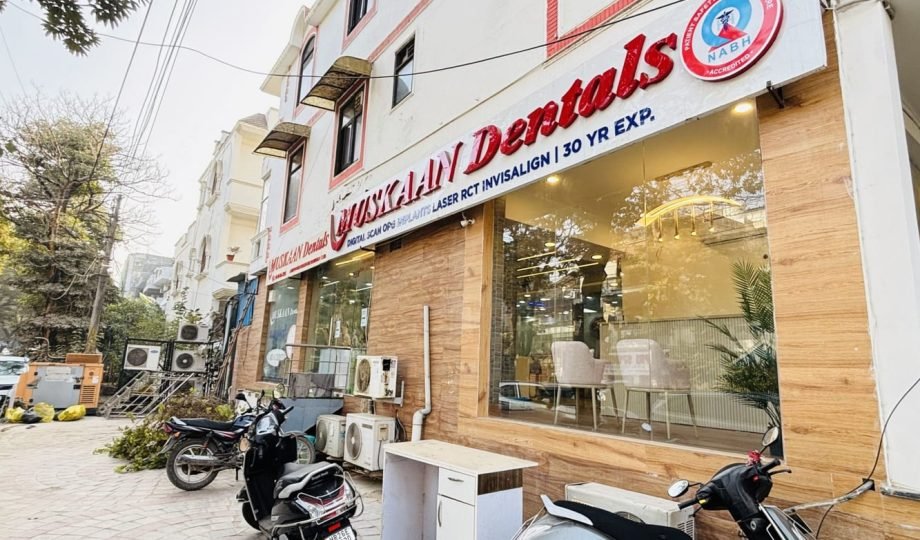
✅ Real clinic photo — already in Media Library (geo-tag with clinic coordinates on upload).
“I was told I don’t have enough bone for an implant.” It is one of the most common conversations in implant dentistry, and one of the most often wrong. Bone loss is genuinely common — after tooth extraction, after gum disease, or with long-term denture wear, the jawbone in that area gradually shrinks. But a shortage of bone is rarely the end of the implant journey. This dentist-reviewed guide explains why bone disappears, how it is measured, and the four main routes that allow fixed teeth even in cases of significant bone loss — including options for implants for low bone density that avoid grafting altogether.
Why Does Bone Disappear in the Jaw?
The jaw needs the stimulation of a tooth root to stay full and dense. Remove the root, and the bone slowly resorbs.
🦷 Missing teeth
Around 25% of bone width is lost in the first year after a tooth is removed, and continues slowly thereafter.
🦠 Gum disease
Advanced periodontitis attacks the bone that holds teeth in place, and the damage often remains after the disease is treated.
🦷 Denture pressure
Long-term removable dentures press on the underlying bone and slowly compress it, especially in the lower jaw.
🩺 Other factors
Osteoporosis, certain medications, smoking, and old infections at extraction sites all contribute to ongoing bone loss.
The earlier an implant is placed after tooth loss, the less bone shrinkage you face. But even years later, modern techniques can almost always create a viable site for a thin bone implant.
What Are the Solutions for Implants After Bone Loss?
🦴 Bone Grafting
Synthetic or natural graft material is added to rebuild the missing bone. Placed alone or alongside the implant.
Best for: Moderate localised bone loss.
⬆️ Sinus Lift
The sinus floor in the upper jaw is gently lifted and the space filled with bone graft, creating height for an upper implant.
Best for: Upper back teeth, short bone.
🔩 Basal Implants
Anchored in the deeper, denser basal bone rather than the surface bone. Often allow fixed teeth without prior grafting.
Best for: Severe loss, faster timeline.
🦴 Zygomatic Implants
Long implants anchored in the cheekbone (zygoma) when upper-jaw bone is severely deficient. Specialist-level surgery.
Best for: Severe upper-jaw bone loss.
🦷 Short / Narrow Implants
Smaller-dimension implants that fit limited bone without grafting. A simple, less invasive option in suitable cases.
Best for: Mild localised shortage.
🦷 All-on-4 (Angled)
Four implants angled to use available bone, supporting a full arch of fixed teeth — often without grafting.
Best for: Full-jaw replacement.
Illustration to add — AI-generated
| 📐 SIZE | 780 × 500 px (WebP, max 150KB) |
| 🏷️ FILE | bone-loss-implant-solutions-illustration.webp |
| 🔤 ALT | Cross-section illustration of four solutions for dental implants after bone loss: bone graft, sinus lift, basal implant, zygomatic implant |
🎨 AI IMAGE PROMPT:
Clean medical infographic on a soft off-white background showing four side-by-side cross-section diagrams of a jawbone with an implant, each illustrating a different solution for bone loss: (1) STANDARD IMPLANT with BONE GRAFT material shown in lighter shade around the implant base, (2) SINUS LIFT with the upper sinus floor lifted and graft material below it supporting the implant, (3) BASAL IMPLANT shown anchored deeper in dense cortical bone with a distinctive T-shape design, (4) ZYGOMATIC IMPLANT shown as a long implant extending from the upper jaw into the cheekbone. Each diagram has a short caption label below. Navy #1a1a2e and red #c0392b accents, blue accent on basal/zygomatic, no baked-in paragraph text (short labels only), professional dental-education aesthetic, flat vector cross-section style.
Clean medical infographic on a soft off-white background showing four side-by-side cross-section diagrams of a jawbone with an implant, each illustrating a different solution for bone loss: (1) STANDARD IMPLANT with BONE GRAFT material shown in lighter shade around the implant base, (2) SINUS LIFT with the upper sinus floor lifted and graft material below it supporting the implant, (3) BASAL IMPLANT shown anchored deeper in dense cortical bone with a distinctive T-shape design, (4) ZYGOMATIC IMPLANT shown as a long implant extending from the upper jaw into the cheekbone. Each diagram has a short caption label below. Navy #1a1a2e and red #c0392b accents, blue accent on basal/zygomatic, no baked-in paragraph text (short labels only), professional dental-education aesthetic, flat vector cross-section style.
Which Route Fits Your Case?
The honest answer is that no one can tell you over the phone — the CBCT scan tells. As a general guide, mild localised bone loss is often handled with a standard or short implant placed directly, sometimes with a small simultaneous graft. Moderate loss typically calls for bone grafting or a sinus lift, with the implant placed at the same time or a few months later. Severe bone loss — long-term edentulous patients, advanced gum-disease cases, or extensive resorption — is where basal implants, zygomatic implants, or angled All-on-4 placement become the appropriate choice. The aim is always to match the technique to your bone, not to push you into the most complex (or most expensive) option by default.
At Muskaan Dentals, every bone loss implant surgery begins with a CBCT scan reviewed in detail by Dr. Suresh Ahlawat (BDS, MDS, DNB USA). You receive a written treatment plan that lists what your bone allows, the recommended technique, timeline, and an all-inclusive cost estimate before any decision is made. Care is delivered across four NABH-accredited branches in Gurgaon — Sector 43 (Sushant Lok), Sector 56, Sector 14, and Sector 52 (Ardee City). CGHS, ECHS, ESIC, and Ayushman Bharat are accepted, with EMI options on implant treatment.
Medically reviewed by Dr. Suresh Ahlawat, BDS, MDS, DNB USA — Chief Implantologist, Muskaan Dentals, Gurgaon. This article is for general information and does not replace a clinical consultation.
Frequently Asked Questions
Dental implants after bone loss in Gurgaon — your common questions answered.
Can I get dental implants if I have bone loss?
Yes, in the great majority of cases. Bone loss in the jaw is common — it happens naturally after a tooth is removed, after gum disease, or with long-term denture wear — and modern implantology has several reliable solutions for it. Depending on how much bone you have and where it is missing, options include bone grafting to rebuild the area first, a sinus lift in the upper jaw, basal implants designed to anchor in deeper bone, or zygomatic implants for severe upper-jaw cases. A CBCT scan at the consultation measures your bone precisely and decides which route fits.
How is bone loss measured before an implant?
A CBCT (cone-beam CT) 3D scan is the standard tool. It produces a detailed three-dimensional image of your jaw, showing exactly how much bone is present in height, width, and density at every potential implant site. This is far more accurate than a regular dental X-ray and is essential for planning a bone loss implant surgery safely. The scan takes a few minutes, exposes you to a low dose of radiation, and the report is reviewed with you at the consultation.
What is the success rate of implants placed after bone loss?
When the right technique is chosen for the available bone — grafting, sinus lift, basal, or zygomatic — success rates closely match those of standard implants in healthy bone, typically in the 90–95% range over 5 to 10 years. The key is matching the technique to the case rather than forcing a standard implant into bone that cannot support it. Dr. Suresh Ahlawat has placed implants in many bone-deficient cases over 35+ years and discusses realistic expectations openly at the consultation.
Does bone grafting hurt and how long does it take to heal?
Bone grafting is performed under local anaesthesia and the procedure itself is comfortable for most patients. Mild swelling and tenderness for a few days is normal, controlled with simple painkillers. Healing time depends on the size of the graft: a small graft placed alongside an implant may heal together with the implant in 3 to 4 months; a larger graft done first usually needs 4 to 6 months before the implant can be placed. The exact timeline is explained in writing before treatment begins.
Are there implants for low bone density that avoid grafting?
Yes. Basal implants are designed to anchor in the deeper, denser basal bone of the jaw and often allow fixed teeth even when conventional bone is thin or missing — without prior grafting in many cases. Short implants, narrow implants, and angled All-on-4 placement are other options that work around bone limitations. Zygomatic implants, anchored in the cheekbone, are reserved for severe upper-jaw bone loss. Which option fits depends on the CBCT findings; each route is explained honestly with its pros, cons, and cost.
How long does the full implant journey take with bone loss?
Anywhere from a few weeks to 9 months, depending on the technique. With sufficient or near-sufficient bone, an implant can be placed in a single visit and fitted with a permanent crown after 3 to 4 months of healing. With moderate bone loss, a graft and implant placed at the same time extend the timeline only slightly. With severe bone loss requiring a separate grafting stage first, the full journey may take 6 to 9 months. A clear timeline is given in writing at the planning stage.
Bone Loss Is Not the End — Let's See Your Options
Book a Free CBCT-Based Implant Consultation in Gurgaon
A CBCT bone scan, an honest assessment of what your bone allows, and a written treatment plan with all-inclusive pricing.
4 branches across Gurgaon · Mon–Sat 10 AM–7 PM · Sunday 11 AM–1 PM
Dr. Suresh Ahlawat · BDS, MDS, DNB USA · 35+ years · NABH · 4.8★ · 1,900+ Reviews
Our Initiatives



For any Queries or assistance please call: +91-94-94-94-7304
MUSKAAN Dentals is 1st NABH ACCREDITED Chain of Speciality dental centers headed by Dr. Suresh Ahlawat BDS, MDS, DNB (USA) having more than 30 Years of National & International experience, Dr. Ahlawat is a Maxillofacial Surgeon Specially trained in Dental Implants in France, Korea, Europe, China and Bangkok etc in various implant systems.
Treatments
Dental Implants
Dental Crowns
Root Canal Treatment
Dental Bridges
Root Canal
Full Mouth Rehabilitation
Clear Aligners
Laser Dentistry
Pediatric Dentistry
Contacts
Address
C-1039, Near Vyapar Kendra, Sushant Lok Phase - 1, Gurgaon, Haryana - 122009
© 2026 Muskaan Dentals Global | All Right Reserved.
Digital Partner: CODEMOTTO