
The implant vs root canal question is really “save the tooth or replace it?” When a tooth can be reliably saved, a root canal is usually the better first choice — nothing beats your own natural tooth. A dental implant is the right answer when the tooth is too damaged to save or a previous root canal has failed. This dentist-reviewed guide explains when to save and when to replace, with honest cost and success-rate comparisons.
⚖️ Save or Replace? — 2026 Guide
Implant vs Root Canal: Should You Save the Tooth or Replace It?
✓ Usually Try First
🦷 Root Canal (Save)
Keeps your own natural tooth, no surgery, lower cost, single-day treatment in many cases. Best when enough healthy tooth and bone remain. Protected with a crown, it can last decades.
When Tooth Can't Be Saved
🦷 Implant (Replace)
The reliable answer when the tooth is cracked below the gum, severely decayed, or a previous root canal has failed. Permanent, 20+ year solution. From ₹25,000 at Muskaan Dentals.
The honest answer: save the tooth if it can be reliably saved — your natural tooth is worth keeping. Choose the implant when the tooth is beyond saving. The tooth's actual condition on an X-ray or CBCT scan decides it, not a price tag.
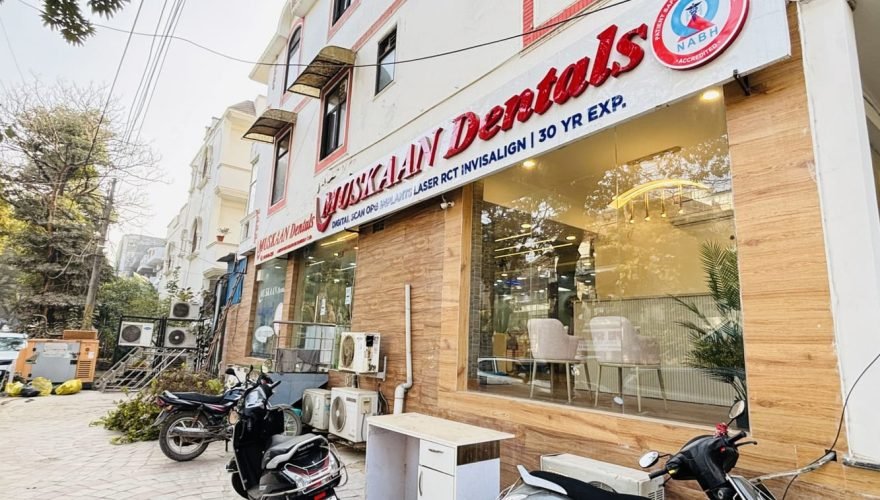
✅ Real clinic photo — already in Media Library (geo-tag with clinic coordinates on upload).
When a tooth becomes badly infected or damaged, you face one of dentistry's most important decisions: save tooth or remove, implant in its place? A root canal treatment (RCT) cleans out the infected nerve and saves the natural tooth; a dental implant removes the tooth entirely and replaces it with a titanium root and crown. These are not interchangeable — one preserves, one replaces — and the right call depends almost entirely on whether the tooth is worth saving. Here is how dentists actually think about it.
Root Canal vs Implant — Side-by-Side
| Factor | 🦷 Root Canal (Save) | 🦷 Implant (Replace) |
|---|---|---|
| Keeps natural tooth | ✓ Yes | ✗ Tooth is removed |
| Surgery needed | ✓ No (non-surgical) | Yes (minor, local anaesthesia) |
| Treatment time | ✓ 1–2 visits + crown | 2–4 months incl. healing |
| Upfront cost | ✓ Lower (RCT + crown) | Higher (from ₹25,000) |
| Lifespan | Decades, if tooth is sound | 20+ years, often lifetime |
| Depends on tooth condition | Needs enough healthy structure | ✓ Works even if tooth is gone |
| Best when… | Tooth is restorable & bone is sound | Tooth is cracked, decayed, or RCT failed |
General guidance — your dentist will tailor the recommendation to the specific tooth.
When Is a Root Canal the Right Choice?
A root canal is usually the first choice whenever the tooth can be reliably saved. If the crown of the tooth is largely intact, the roots are sound, and the surrounding bone is healthy, cleaning out the infected nerve and sealing the tooth — then protecting it with a crown — keeps your natural tooth in place. Saving a natural tooth preserves the natural root, the bite, and the bone, and avoids surgery. Dentists generally agree: a tooth that can be saved well is worth saving.
When Is an Implant the Better Choice?
An implant becomes the more reliable option when the tooth simply cannot be saved — for example, a vertical crack extending below the gum line, decay so extensive that too little tooth remains to hold a crown, severe gum disease that has destroyed the supporting bone, or a previous root canal that has failed despite re-treatment. In these cases, persisting with attempts to save a doomed tooth can cost more in the long run than removing it and placing a well-planned implant. This is the root canal failure implant scenario many patients reach — and the implant gives them a permanent, dependable result.
Illustration to add — AI-generated
| 📐 SIZE | 600 × 600 px (WebP, max 150KB) |
| 🏷️ FILE | root-canal-vs-implant-comparison-illustration.webp |
| 🔤 ALT | Illustration comparing a root canal saving a tooth versus an implant replacing it |
🎨 AI IMAGE PROMPT:
Clean medical illustration comparing two options for a damaged tooth, side by side on a soft off-white background: LEFT — a root canal treatment showing a natural tooth with cleaned canals sealed and a crown on top (labelled SAVE); RIGHT — the tooth removed and replaced by a titanium dental implant with crown in the jawbone (labelled REPLACE). Simple labelled cross-section diagram style, navy #1a1a2e and red #c0392b accents, no baked-in paragraph text, professional dental-education aesthetic, flat vector look.
Clean medical illustration comparing two options for a damaged tooth, side by side on a soft off-white background: LEFT — a root canal treatment showing a natural tooth with cleaned canals sealed and a crown on top (labelled SAVE); RIGHT — the tooth removed and replaced by a titanium dental implant with crown in the jawbone (labelled REPLACE). Simple labelled cross-section diagram style, navy #1a1a2e and red #c0392b accents, no baked-in paragraph text, professional dental-education aesthetic, flat vector look.
RCT vs Implant Cost in Gurgaon — The Real Comparison
A root canal usually costs less upfront — but the true cost depends on whether the saved tooth lasts.
🦷 Root Canal + Crown
Upfront: lower than an implant.
Value: excellent when the tooth has a good prognosis.
Watch-out: paying for RCT + crown on a doomed tooth that fails in a few years can cost more than going straight to an implant.
🦷 Dental Implant
Upfront: from ₹25,000 all-inclusive.
Value: a permanent solution when the tooth can't be saved.
Watch-out: not worth choosing over a tooth that could have been saved well.
The smartest way to compare RCT vs implant cost is to ask: which option will still be working in ten years? At Muskaan Dentals, we give you that honest prognosis at the consultation, with a written estimate for whichever route is right. We're empanelled with CGHS, ECHS, ESIC, and Ayushman Bharat, and offer EMI on implant treatment.
Medically reviewed by Dr. Suresh Ahlawat, BDS, MDS, DNB USA — Chief Implantologist, Muskaan Dentals, Gurgaon. This article is for general information and does not replace a clinical consultation. Where a tooth can be saved, Muskaan Dentals recommends saving it.
Frequently Asked Questions
Implant vs root canal — your common questions answered.
Is it better to save a tooth with a root canal or remove it for an implant?
Whenever a tooth can be reliably saved, a root canal is usually the better first choice — nothing functions quite like your own natural tooth, and it avoids surgery. A dental implant becomes the better option when the tooth is too damaged, cracked, or decayed to save, when a previous root canal has failed, or when there is severe bone or gum disease around the tooth. The honest answer depends on the condition of that specific tooth, which an X-ray or CBCT scan reveals.
What is the cost of a root canal vs an implant in Gurgaon?
A root canal (with a crown) generally costs less than a dental implant. At Muskaan Dentals, dental implants start from ₹25,000 all-inclusive. A root canal plus crown is typically lower. However, if the tooth is unlikely to survive long term, paying for a root canal and crown that fails within a few years can end up costing more than going straight to an implant. The most economical choice is the one that lasts — which is why the tooth's prognosis matters more than the sticker price.
What happens if a root canal fails — can I get an implant?
Yes. If a root canal fails — due to re-infection, a cracked root, or persistent pain — the tooth can be removed and replaced with a dental implant. In many cases a re-treatment or apicoectomy is tried first to save the tooth; if those are not viable, an implant is an excellent permanent replacement. A CBCT scan helps determine whether the tooth can still be saved or whether an implant is the better path.
Which lasts longer, a root canal tooth or an implant?
Both can last many years when done well. A successfully root-canal-treated tooth protected by a crown can last for decades, and keeping your natural tooth has real advantages. A dental implant also lasts 20+ years and can outlast a compromised natural tooth. The deciding factor is the starting condition of the tooth: a structurally sound tooth is best saved; a badly broken-down tooth is often better replaced.
Is a root canal painful compared to an implant?
Modern root canals are performed under local anaesthesia and are generally no more uncomfortable than a routine filling. Implant placement is also done under local anaesthesia and is well tolerated, with most discomfort manageable with simple painkillers. Neither procedure is the painful ordeal many people imagine — and at Muskaan Dentals, patient comfort is a priority for both.
How do I decide between a root canal and an implant?
Have the tooth assessed with an X-ray or CBCT scan. If enough healthy tooth structure remains and the supporting bone is sound, saving it with a root canal and crown is usually recommended first. If the tooth is cracked below the gum, severely decayed, or has a failed previous root canal, an implant is often the more reliable long-term solution. Dr. Suresh Ahlawat assesses each tooth individually and recommends saving it wherever that is the sounder choice.
We'll Try to Save It First
Book a Free Assessment — Save or Replace?
An X-ray or CBCT scan and honest advice on whether your tooth can be saved — and a written estimate either way.
4 branches across Gurgaon · Mon–Sat 10 AM–7 PM · Sunday 11 AM–1 PM
Reviewed by Dr. Suresh Ahlawat · BDS, MDS, DNB USA · 35+ years · NABH · 4.8★ · 1,900+ Reviews
Our Initiatives



For any Queries or assistance please call: +91-94-94-94-7304
MUSKAAN Dentals is 1st NABH ACCREDITED Chain of Speciality dental centers headed by Dr. Suresh Ahlawat BDS, MDS, DNB (USA) having more than 30 Years of National & International experience, Dr. Ahlawat is a Maxillofacial Surgeon Specially trained in Dental Implants in France, Korea, Europe, China and Bangkok etc in various implant systems.
Treatments
Dental Implants
Dental Crowns
Root Canal Treatment
Dental Bridges
Root Canal
Full Mouth Rehabilitation
Clear Aligners
Laser Dentistry
Pediatric Dentistry
Contacts
Address
C-1039, Near Vyapar Kendra, Sushant Lok Phase - 1, Gurgaon, Haryana - 122009
© 2026 Muskaan Dentals Global | All Right Reserved.
Digital Partner: CODEMOTTO