
Ridge augmentation Gurgaon rebuilds the width or height of the jawbone before a dental implant when the ridge has shrunk too far for a standard implant. This dentist-reviewed guide explains horizontal and vertical augmentation, the staged 9–12 month timeline from ridge augmentation before implant to final crown, materials used, and how Muskaan Dentals handles complex bone ridge cases.
🧱 Specialist Bone Rebuild • NABH Accredited
Ridge Augmentation Gurgaon for Dental Implants
Rebuilding the Foundation
Ridge augmentation Gurgaon is a bone-rebuilding surgical procedure that restores the width or height of the jawbone before a dental implant can be placed. It is the specialist answer when years of tooth loss, gum disease, or denture wear have shrunk the ridge too far for a standard implant. Horizontal augmentation widens; vertical augmentation increases height; both can be combined. At Muskaan Dentals, Dr. Suresh Ahlawat (BDS, MDS, DNB USA, 35+ years) handles complex ridge cases personally.
Horizontal
Widens narrow ridge
Vertical
Increases ridge height
4–6 mo
Healing before implant
80–95%
Success rate
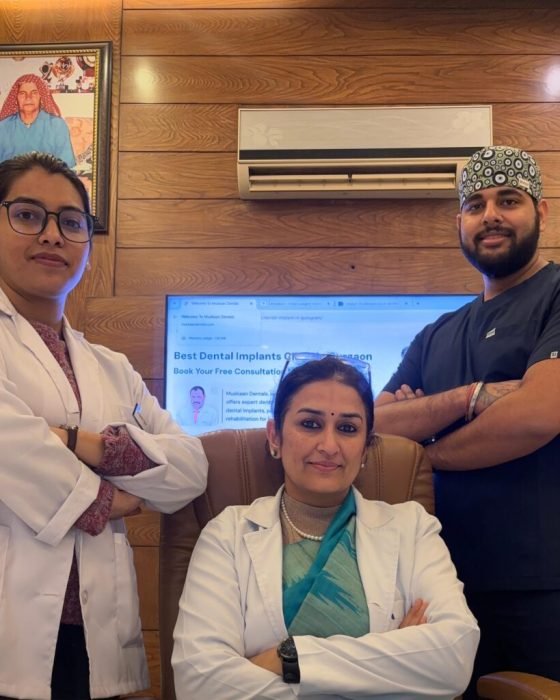
✅ Real clinic photo — already in Media Library (geo-tag with clinic coordinates on upload).
For patients who have been told their jawbone is too narrow or too short for a standard dental implant, ridge augmentation is the specialist procedure that changes that. By rebuilding the missing bone of the alveolar ridge — the tooth-bearing portion of the jaw — it transforms a site that cannot support an implant into one that can. This dentist-reviewed guide explains what jaw ridge rebuild surgery involves, how horizontal and vertical augmentation differ, the timeline from ridge augmentation before implant placement to final crown, and how Muskaan Dentals handles complex bone ridge Gurgaon cases.
What Is Ridge Augmentation and When Is It Needed?
The alveolar ridge is the bony arch of the jaw that holds tooth roots. When a tooth is lost, the bone in that area gradually shrinks because it no longer has a root stimulating it. After years, the ridge can become too narrow, too short, or both — insufficient to anchor a standard implant safely. Ridge augmentation surgically adds bone graft material to rebuild the missing volume, giving the implant a stable home. It is most commonly needed in three situations: long-standing missing teeth (years between extraction and implant), advanced gum disease that destroyed surrounding bone, and trauma cases where bone was lost alongside the tooth.
Horizontal, Vertical, or Combined — Which Does Your Case Need?
MORE PREDICTABLE
↔️ Horizontal Augmentation
Widens a knife-edged ridge that has the right height but is too thin. Graft material is placed laterally and covered with a membrane to encourage new bone formation.
Success: ~90–95% over 5 years.
MORE COMPLEX
↕️ Vertical Augmentation
Increases ridge height where the bone has resorbed downwards. Technically demanding because gaining height against gravity is biologically harder than gaining width.
Success: ~80–90% over 5 years.
SPECIALIST CASES
⦿ Combined (3D)
Severe atrophy needing both width and height correction — essentially rebuilding the ridge in three dimensions. May be done in stages over 6–12 months.
Reserved for the most severe bone loss cases.
Illustration to add — AI-generated
| 📐 SIZE | 780 × 560 px (WebP, max 150KB) |
| 🏷️ FILE | ridge-augmentation-cross-section-illustration.webp |
| 🔤 ALT | Cross-section illustration of ridge augmentation: narrow jaw ridge before augmentation, widened ridge with graft material and dental implant placed successfully, and a vertical augmentation diagram |
🎨 AI IMAGE PROMPT:
Clean medical infographic on a soft off-white background showing two side-by-side cross-section diagrams of a jawbone ridge: LEFT ‘BEFORE — NARROW RIDGE’ showing a knife-edged thin alveolar ridge with insufficient width for an implant. RIGHT ‘AFTER — HORIZONTAL AUGMENTATION’ showing the same ridge widened by graft material in a lighter shade, with a barrier membrane visible as a dashed line, and a dental implant successfully placed in the widened bone. Below the two diagrams, a smaller third diagram showing VERTICAL AUGMENTATION: a short ridge increased in height with graft material visible at the top. Each diagram has clear short labels. Navy #1a1a2e and red #c0392b accents, green tick on the AFTER state. No baked-in paragraph text beyond short anatomical labels. Professional dental-surgical education aesthetic, flat vector cross-section style.
Clean medical infographic on a soft off-white background showing two side-by-side cross-section diagrams of a jawbone ridge: LEFT ‘BEFORE — NARROW RIDGE’ showing a knife-edged thin alveolar ridge with insufficient width for an implant. RIGHT ‘AFTER — HORIZONTAL AUGMENTATION’ showing the same ridge widened by graft material in a lighter shade, with a barrier membrane visible as a dashed line, and a dental implant successfully placed in the widened bone. Below the two diagrams, a smaller third diagram showing VERTICAL AUGMENTATION: a short ridge increased in height with graft material visible at the top. Each diagram has clear short labels. Navy #1a1a2e and red #c0392b accents, green tick on the AFTER state. No baked-in paragraph text beyond short anatomical labels. Professional dental-surgical education aesthetic, flat vector cross-section style.
What Is the Timeline From Augmentation to Final Crown?
A staged ridge augmentation case typically follows a 9–12 month timeline. The first step is the augmentation surgery itself: graft material is placed under the gum, a barrier membrane covers it to protect the new bone from soft-tissue infiltration (guided bone regeneration), and the gum is closed. The site then heals for 4–6 months while new bone forms. After confirmation of adequate bone on a follow-up CBCT, the implant is placed in a second surgery. Another 3–4 months of healing allows the implant to fuse with the new bone, after which the final permanent crown is fitted. A temporary tooth covers any visible gap throughout, so daily life is not visibly affected.
In smaller, localised cases the augmentation and implant can sometimes be combined in a single surgery (simultaneous augmentation and implant placement). The CBCT scan at consultation decides whether your case suits the staged or simultaneous approach — staged is more conservative and reliable for larger defects; simultaneous is faster when the defect is small.
How Muskaan Dentals Handles Complex Ridge Cases
Ridge augmentation is not a procedure to be undertaken at every dental clinic — it requires specific surgical training, the right armamentarium, and case selection experience. At Muskaan Dentals, all ridge augmentation cases are personally overseen by Dr. Suresh Ahlawat (BDS, MDS, DNB USA, 35+ years), with international training in advanced bone-grafting techniques in France, Korea, Europe, China, and Bangkok. Cases are planned from CBCT 3D imaging, executed in NABH-accredited surgical conditions, and supported by a written staged treatment plan that lists each surgical step, healing window, and all-inclusive cost upfront — no surprises mid-treatment. Care is delivered across four Gurgaon branches: Sector 43 (Sushant Lok), Sector 56, Sector 14, and Sector 52 (Ardee City). Where ridge augmentation is genuinely not the right answer for your case, we will say so and explain the alternatives — basal implants, zygomatic implants, or staged plans — honestly.
Medically reviewed by Dr. Suresh Ahlawat, BDS, MDS, DNB USA — Chief Implantologist, Muskaan Dentals, Gurgaon. This article is for general information and does not replace a clinical consultation.
Frequently Asked Questions
Ridge augmentation in Gurgaon — your common questions answered.
What is ridge augmentation and why might I need it?
Ridge augmentation is a bone-rebuilding surgical procedure that restores the width or height of the alveolar ridge — the part of the jawbone that holds teeth. It is needed when years of tooth loss, gum disease, trauma, or long-term denture wear have caused the ridge to shrink, leaving too little bone for a standard dental implant. The procedure rebuilds the missing bone using graft material, allowing implants to be placed successfully in a site that otherwise could not support one. Without it, patients with significant ridge loss would be limited to dentures or specialist solutions like basal implants.
What is the difference between horizontal and vertical ridge augmentation?
Horizontal ridge augmentation widens a ridge that has become too narrow for an implant — the bone has the right height but is knife-edged. Vertical ridge augmentation increases the height of a ridge that has shrunk downwards. Some cases need both. Horizontal augmentation is generally more predictable and has higher success rates (typically 90–95%). Vertical augmentation is more technically demanding (success around 80–90%) because gaining height is biologically harder than gaining width. A CBCT 3D scan determines exactly what your case needs.
How long does ridge augmentation take to heal before an implant?
Typically 4–6 months between the augmentation and the implant placement, depending on the size of the graft. Smaller localised grafts may heal in 3–4 months and sometimes allow simultaneous implant placement. Larger or vertical augmentations usually require a separate healing stage before implants can be placed safely. A temporary tooth covers any visible gap during this period. The whole journey from initial consultation to final crown commonly spans 9–12 months for a ridge augmentation case — longer than a standard implant but predictable, with each stage planned and explained in writing.
What graft material is used in ridge augmentation at Muskaan Dentals?
We use the material best suited to each case rather than a one-size-fits-all approach. Options include autograft (your own bone, taken from elsewhere in the jaw — considered the gold standard for healing), allograft (processed donor bone), xenograft (bovine or porcine origin, widely studied and safe), and synthetic materials (beta-tricalcium phosphate, hydroxyapatite). A resorbable or non-resorbable membrane is usually placed over the graft to support guided bone regeneration (GBR). Dr. Suresh Ahlawat selects the material based on graft size, location, and patient preference — discussed openly at the planning stage.
How much does ridge augmentation cost in Gurgaon?
Costs vary by the size and complexity of the augmentation. A small localised graft alongside a single implant is the most affordable option and adds modestly to a standard implant cost. A larger separate augmentation procedure done before implant placement costs more because it is a distinct surgical stage with its own healing time. Vertical augmentations are typically more expensive than horizontal because of the greater technical complexity and longer healing protocol. A written, all-inclusive estimate listing materials, surgical stages, and the implant cost is provided at consultation — with no hidden charges added later.
Is ridge augmentation painful and what is the recovery like?
The procedure itself is performed under local anaesthesia and most patients describe it as comfortable. Mild to moderate swelling, bruising, and tenderness for 3–7 days afterwards is normal, controlled with simple painkillers. Soft foods are recommended for the first week, and meticulous oral hygiene is essential during healing. Sutures are typically removed at 10–14 days. Most patients return to normal activities within a few days and to normal eating within 2 weeks. Detailed written aftercare instructions are given before you leave the clinic.
Told Your Bone Is Too Thin for an Implant? Get a Second Opinion.
Book a Free CBCT-Based Consultation in Gurgaon
A CBCT 3D scan, an honest assessment of whether ridge augmentation is right for you, and a written staged treatment plan with materials, timelines, and all-inclusive costs.
4 NABH branches across Gurgaon · Mon–Sat 10 AM–7 PM · Sunday 11 AM–1 PM
Dr. Suresh Ahlawat · BDS, MDS, DNB USA · 35+ years · NABH · 4.8★ · 1,900+ Reviews
Our Initiatives



For any Queries or assistance please call: +91-94-94-94-7304
MUSKAAN Dentals is 1st NABH ACCREDITED Chain of Speciality dental centers headed by Dr. Suresh Ahlawat BDS, MDS, DNB (USA) having more than 30 Years of National & International experience, Dr. Ahlawat is a Maxillofacial Surgeon Specially trained in Dental Implants in France, Korea, Europe, China and Bangkok etc in various implant systems.
Treatments
Dental Implants
Dental Crowns
Root Canal Treatment
Dental Bridges
Root Canal
Full Mouth Rehabilitation
Clear Aligners
Laser Dentistry
Pediatric Dentistry
Contacts
Address
C-1039, Near Vyapar Kendra, Sushant Lok Phase - 1, Gurgaon, Haryana - 122009
© 2026 Muskaan Dentals Global | All Right Reserved.
Digital Partner: CODEMOTTO