
An implant after failed root canal is one of three options — alongside root canal retreatment and apex surgery. Saving the tooth is usually preferable when feasible; an implant becomes the right call when the tooth is fractured, structurally compromised, or has already failed retreatment. This dentist-reviewed guide explains all three routes and when each fits at Muskaan Dentals, Gurgaon.
🦷 Three Options — Save First, Replace When Needed
Implant After Failed Root Canal in Gurgaon
Quick Answer — Three Options, Not One
A failed root canal has three possible routes: retreatment (reopen and re-clean the canals), apicoectomy (small surgery at the root tip), or extraction and implant. Saving the natural tooth is usually preferred when feasible; an implant after failed root canal becomes the right choice when the tooth is fractured, repeatedly infected, or beyond rebuilding. A CBCT scan decides which route fits. Dr. Suresh Ahlawat (DNB USA, 35+ years) reviews every case honestly.
1️⃣ Retreat
First option when tooth is intact.
2️⃣ Apex surgery
When retreatment isn’t possible.
3️⃣ Extract + implant
When the tooth can’t be saved.
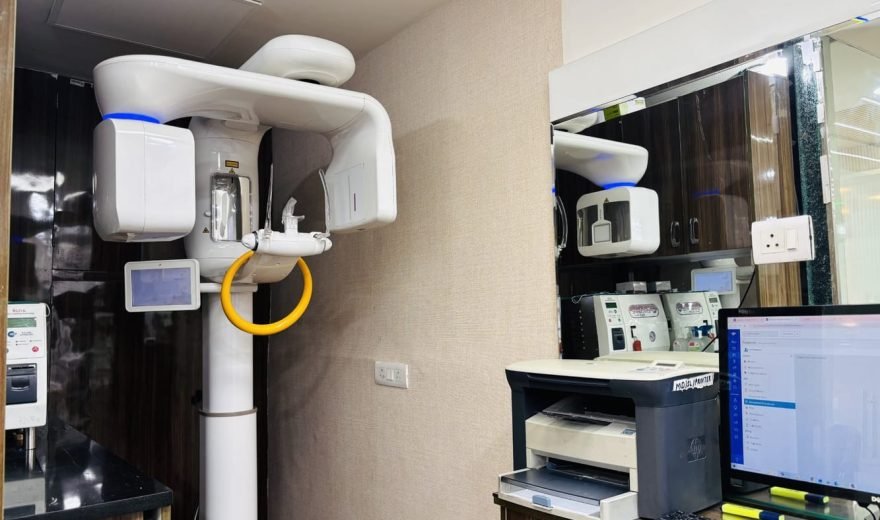
✅ Real clinic photo — already in Media Library (geo-tag with clinic coordinates on upload).
A root canal that has stopped working — pain returning, swelling that won’t go, an infection showing on the X-ray — is one of the more frustrating situations in dentistry, especially after you have already gone through one treatment. The good news is that a failed root canal is not the end of the road for the tooth, and even when the tooth itself cannot be saved, a modern dental implant provides a fixed, permanent replacement that functions just like a natural tooth. This dentist-reviewed guide explains why root canals sometimes fail, what your three real options are, and when an extract and implant approach is the right call.
Why Does a Root Canal Fail?
Root canals succeed in roughly 85–95% of cases over 10 years. When they fail, the reason almost always falls into one of four categories.
🦠 Missed canal
A small accessory canal was not detected or fully cleaned during the original treatment, leaving bacteria behind to flare up later.
🦷 New crack
A treated tooth becomes more brittle. A fresh fracture, especially down the root, allows bacteria back in and can make the tooth unsalvageable.
🛡️ Leaking crown
A worn or poorly-fitting crown or filling allows saliva and bacteria to seep down into the sealed root, restarting the infection.
🔄 Reinfection
Persistent low-grade infection at the root tip that never fully cleared, sometimes showing up only on a routine X-ray years later.
A CBCT 3D scan shows exactly which of these is at play — and that decides whether the tooth can still be rescued or whether it is time to consider failed rct tooth replacement with an implant.
What Are Your Three Options After a Failed Root Canal?
OPTION 1 — SAVE
🦷 Root Canal Retreatment
The tooth is reopened, the old root canal filling is removed, the canals are re-cleaned (often with a microscope to find missed canals), and the tooth is re-sealed and re-crowned.
Best for: Tooth structure intact, no fracture. Success: ~75–85%.
OPTION 2 — SAVE
🔧 Apicoectomy (Apex Surgery)
A small surgical procedure to access the tip of the root from above the gum, remove the infected portion, and seal the end of the root. Used when retreatment is not feasible or has not worked.
Best for: Persistent infection at root tip only. Success: ~70–80%.
OPTION 3 — REPLACE
🦷 Extract & Implant
The tooth is removed, the area is allowed to heal (or implant placed immediately if conditions allow), and a titanium implant with crown becomes the permanent replacement.
Best for: Fracture, structural loss, repeated failure. Success: ~95%+.
Illustration to add — AI-generated
| 📐 SIZE | 780 × 560 px (WebP, max 150KB) |
| 🏷️ FILE | failed-rct-three-options-illustration.webp |
| 🔤 ALT | Decision-tree illustration of three options after a failed root canal: retreatment, apicoectomy, extraction and implant, with success rates |
🎨 AI IMAGE PROMPT:
Clean medical infographic on a soft off-white background showing a decision tree for a failed root canal, with three branching paths from a central tooth diagram (showing a previously-treated tooth with infection at the root tip). Branch 1: RETREATMENT — small icon of the tooth being reopened and re-cleaned, success rate label ‘~75-85%’. Branch 2: APICOECTOMY — icon of a small surgical access at the root tip from above the gum, label ‘~70-80%’. Branch 3: EXTRACT + IMPLANT — icon of the tooth being replaced by a titanium implant with crown, label ‘~95%+’. Arrows connect the central tooth to each option. Navy #1a1a2e and red #c0392b accents, green and orange and navy as decision indicators on the three branches, no baked-in paragraph text (short labels only), professional dental-education aesthetic, flat vector decision-tree style.
Clean medical infographic on a soft off-white background showing a decision tree for a failed root canal, with three branching paths from a central tooth diagram (showing a previously-treated tooth with infection at the root tip). Branch 1: RETREATMENT — small icon of the tooth being reopened and re-cleaned, success rate label ‘~75-85%’. Branch 2: APICOECTOMY — icon of a small surgical access at the root tip from above the gum, label ‘~70-80%’. Branch 3: EXTRACT + IMPLANT — icon of the tooth being replaced by a titanium implant with crown, label ‘~95%+’. Arrows connect the central tooth to each option. Navy #1a1a2e and red #c0392b accents, green and orange and navy as decision indicators on the three branches, no baked-in paragraph text (short labels only), professional dental-education aesthetic, flat vector decision-tree style.
When Is Extraction and Implant the Right Choice?
Saving the natural tooth is generally preferable when feasible — your own tooth has the best biology, and root-canal retreatment has a reasonable success rate. However, an implant becomes the more honest recommendation in several clear situations: a vertical root fracture (the tooth is split and cannot be sealed reliably), severe loss of tooth structure (less than half the natural crown remaining, making a new crown unstable), repeated retreatment that has already failed, and cases where retreatment would cost as much as an implant but with a 70% chance of working versus 95% for an implant. In all these situations, persisting with the natural tooth often means paying for treatment twice and ending up at the implant anyway.
Where conditions allow, the implant can be placed immediately at the time of extraction (“immediate implant”), reducing the overall timeline. Where there is significant infection, bone loss, or a complex extraction, the site is allowed to heal for a few months first. A temporary tooth bridges the gap in visible areas so you are never seen with a missing front tooth.
At Muskaan Dentals, every rct failure treatment consultation starts with a CBCT scan reviewed by Dr. Suresh Ahlawat (BDS, MDS, DNB USA). You receive a written treatment plan that lists all three options honestly, with their pros, cons, success rates, and all-inclusive costs. The aim is to recommend the right route for your tooth, not the most expensive one. CGHS, ECHS, ESIC, and Ayushman Bharat are accepted, with EMI options on implant treatment, across four NABH-accredited branches in Gurgaon — Sector 43 (Sushant Lok), Sector 56, Sector 14, and Sector 52 (Ardee City).
Medically reviewed by Dr. Suresh Ahlawat, BDS, MDS, DNB USA — Chief Implantologist, Muskaan Dentals, Gurgaon. This article is for general information and does not replace a clinical consultation.
Frequently Asked Questions
Implant after failed root canal in Gurgaon — your common questions answered.
Can a failed root canal be saved or does it need extraction?
Often it can still be saved. The first option is root canal retreatment — the tooth is reopened, the old filling removed, the canals re-cleaned and re-sealed. If retreatment is not possible or has already been tried, a small surgery called apicoectomy can sometimes remove the infected tip of the root and save the tooth. Extraction and implant is the last resort, used when the tooth is structurally too damaged, cracked into the root, or repeated treatment has not resolved the infection. A CBCT scan and clinical exam decide which path fits.
Why does a root canal sometimes fail?
Root canals succeed in the great majority of cases, but a small percentage fail over time. The common reasons are: a missed accessory canal that still harbours bacteria, a new fracture or crack in the tooth, leakage from a worn-down crown or filling allowing new infection in, or reinfection through the root tip. Sometimes a tooth simply has anatomy too complex for one round of treatment to fully clean. Modern microscopes, CBCT imaging, and improved sealing materials have raised first-time success rates significantly compared to a decade ago.
How do I know if my root canal has failed?
Persistent or returning pain, tenderness when biting, swelling near the tooth, a small pimple-like bump on the gum that drains, or a darkening of the tooth are the common warning signs. Sometimes a failed root canal is silent and is found only on a routine X-ray showing infection at the root tip. If you have had a root canal in the past and any of these signs appear, it is worth getting it assessed — a CBCT scan at the consultation gives a clear picture of what is happening below the surface.
Is extraction and implant better than retreating a failed root canal?
Not automatically. Retreatment is usually attempted first when the tooth still has good structure and the root is intact, because keeping your natural tooth is generally preferable when feasible. Extraction and implant becomes the better choice when the tooth has a vertical root fracture, when retreatment has already failed once, when there is severe loss of tooth structure, or when the cost and complexity of saving the tooth no longer makes clinical sense. Dr. Suresh Ahlawat reviews each case individually and recommends the option that fits, not the more expensive one by default.
How long does the implant journey take after a failed root canal?
Typically 3 to 6 months from extraction to final crown, depending on the case. If the bone is healthy at the time of extraction, an implant can sometimes be placed immediately in the same visit (immediate implant). If there is infection or significant bone loss, the site is allowed to heal for 2 to 4 months first, then the implant is placed, followed by 3 to 4 months of healing before the permanent crown. A temporary tooth can be fitted in visible areas so you are never without a tooth in the front of your mouth.
Where can I get an implant after a failed RCT in Gurgaon?
Muskaan Dentals offers full failed-RCT assessment and implant care across four NABH-accredited branches in Gurgaon — Sector 43 (Sushant Lok), Sector 56, Sector 14, and Sector 52 (Ardee City). All complex implant cases are overseen by Dr. Suresh Ahlawat (BDS, MDS, DNB USA, 35+ years). The first consultation is free, includes a CBCT scan review, and you receive a written treatment plan listing every option — retreatment, surgery, or implant — with honest pros, cons, and costs.
Failed RCT? Get All Three Options Reviewed Honestly
Book a Free CBCT-Based Consultation in Gurgaon
A CBCT scan, an honest assessment of whether the tooth can still be saved, and a written plan with the pros, cons, and costs of all three options.
4 branches across Gurgaon · Mon–Sat 10 AM–7 PM · Sunday 11 AM–1 PM
Dr. Suresh Ahlawat · BDS, MDS, DNB USA · 35+ years · NABH · 4.8★ · 1,900+ Reviews
Our Initiatives



For any Queries or assistance please call: +91-94-94-94-7304
MUSKAAN Dentals is 1st NABH ACCREDITED Chain of Speciality dental centers headed by Dr. Suresh Ahlawat BDS, MDS, DNB (USA) having more than 30 Years of National & International experience, Dr. Ahlawat is a Maxillofacial Surgeon Specially trained in Dental Implants in France, Korea, Europe, China and Bangkok etc in various implant systems.
Treatments
Dental Implants
Dental Crowns
Root Canal Treatment
Dental Bridges
Root Canal
Full Mouth Rehabilitation
Clear Aligners
Laser Dentistry
Pediatric Dentistry
Contacts
Address
C-1039, Near Vyapar Kendra, Sushant Lok Phase - 1, Gurgaon, Haryana - 122009
© 2026 Muskaan Dentals Global | All Right Reserved.
Digital Partner: CODEMOTTO