
3D guided implant surgery Gurgaon at Muskaan Dentals — CBCT 3D scanning, digital implant planning software, and custom 3D-printed surgical guides for placement deviation under 1 mm. This dentist-reviewed guide explains the workflow, the real advantages over freehand placement, and when 3D guidance is genuinely worth the extra step.
💻 Digital Planning • Precise Placement
3D Guided Implant Surgery in Gurgaon
Implants Planned on a Computer Before Surgery
3D guided implant surgery Gurgaon takes implant placement from “skilled judgement in real time” to “pre-planned to a fraction of a millimetre.” A CBCT 3D scan of your jaw is loaded into planning software where Dr. Suresh Ahlawat designs the exact implant position, angle, and depth before you ever sit in the chair. A custom surgical guide is then 3D-printed to execute that plan precisely. The result: placement deviation under 1 mm, often flapless surgery, faster procedure, better prosthetic outcomes.
CBCT
3D scan
Digital
Planning software
3D Guide
Custom-printed
< 1mm
Placement deviation
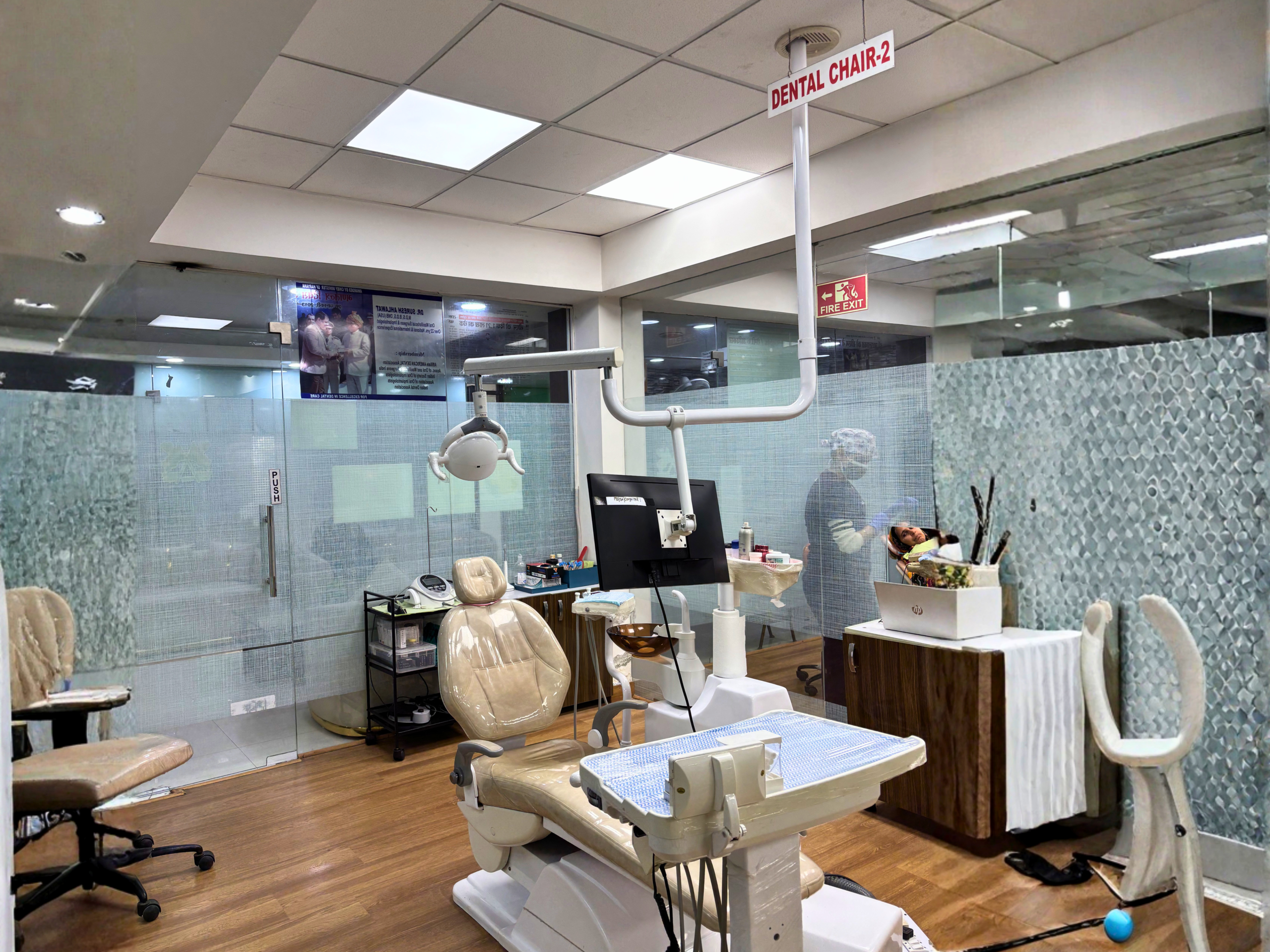
✅ Real clinic photo — already in Media Library (geo-tag with clinic coordinates on upload).
Twenty years ago, dental implant placement relied entirely on the surgeon’s eye, hand, and experience. Today, the entire surgery can be planned on a computer screen before the patient sits in the chair — implant position, angle, depth, and the final crown all designed digitally, then executed precisely using a custom 3D-printed surgical guide. This dentist-reviewed guide explains how 3D guided implant surgery Gurgaon works at Muskaan Dentals, what digital implant planning involves, where it genuinely improves outcomes, and where traditional placement remains the right choice.
What Is 3D Guided Implant Surgery?
3D guided implant surgery is the modern, computer-planned alternative to freehand implant placement. The process starts with a CBCT (cone-beam CT) 3D scan of your jaw, which captures the precise position of bone, nerves, sinuses, and any remaining teeth. This 3D data is loaded into specialist implant planning software — the same kind used in academic dental centres worldwide. Dr. Suresh Ahlawat virtually positions each implant in the ideal location: optimal bone engagement, safe distance from the nerve canal or sinus floor, correct angulation for the final crown, and proper spacing between implants. Once the digital plan is approved, a custom surgical guide is 3D-printed or milled — a precise physical template that fits over your teeth or gums during surgery, allowing each implant to be placed exactly along pre-designed channels.
How Does the Digital Implant Planning Process Work?
STEP 1
📸 CBCT 3D Scan
A short (under 1 minute) low-dose 3D scan captures your jaw anatomy in detail: bone thickness, density, nerve and sinus positions. Done in-house at Muskaan Dentals.
STEP 2
💻 Digital Planning
CBCT data is loaded into implant planning software. Dr. Suresh Ahlawat virtually places each implant in the ideal position — the planning is reviewed with you before the guide is made.
STEP 3
🖨️ Surgical Guide Made
The custom guide is 3D-printed or milled from the digital design. It typically takes 5–7 days to manufacture and arrives ready for surgery day, sterilised.
STEP 4
✅ Guided Surgery
The guide is positioned in your mouth and each implant is placed through pre-designed channels. Often flapless (no major gum cut). Faster, more precise, less swelling afterwards.
Illustration to add — AI-generated
| 📐 SIZE | 780 × 500 px (WebP, max 150KB) |
| 🏷️ FILE | 3d-guided-implant-surgery-workflow-illustration.webp |
| 🔤 ALT | Workflow infographic showing the four steps of 3D guided dental implant surgery: CBCT 3D scan, digital implant planning, 3D printed surgical guide, and precision placement |
🎨 AI IMAGE PROMPT:
Clean medical infographic on a soft off-white background showing a horizontal four-step workflow for 3D guided dental implant surgery. Step 1: a CBCT scanner icon labelled 'CBCT 3D SCAN' with a patient head outline being scanned. Step 2: a computer screen showing a virtual 3D jawbone with a dental implant being positioned in software, labelled 'DIGITAL PLANNING'. Step 3: a 3D printer icon producing a small surgical guide template, labelled '3D PRINTED GUIDE'. Step 4: a jaw cross-section showing the surgical guide fitted over the gum with an implant being placed through a precision channel, labelled 'PRECISION PLACEMENT'. Arrows connect the four stages. Below the workflow, a small comparison note: 'Deviation < 1mm vs 2-3mm freehand'. Navy #1a1a2e and red #c0392b accents, blue accent on the digital/technology steps, green tick on the final precision placement. No baked-in paragraph text beyond short step labels. Professional dental-technology aesthetic, flat vector workflow style.
Clean medical infographic on a soft off-white background showing a horizontal four-step workflow for 3D guided dental implant surgery. Step 1: a CBCT scanner icon labelled 'CBCT 3D SCAN' with a patient head outline being scanned. Step 2: a computer screen showing a virtual 3D jawbone with a dental implant being positioned in software, labelled 'DIGITAL PLANNING'. Step 3: a 3D printer icon producing a small surgical guide template, labelled '3D PRINTED GUIDE'. Step 4: a jaw cross-section showing the surgical guide fitted over the gum with an implant being placed through a precision channel, labelled 'PRECISION PLACEMENT'. Arrows connect the four stages. Below the workflow, a small comparison note: 'Deviation < 1mm vs 2-3mm freehand'. Navy #1a1a2e and red #c0392b accents, blue accent on the digital/technology steps, green tick on the final precision placement. No baked-in paragraph text beyond short step labels. Professional dental-technology aesthetic, flat vector workflow style.
What Are the Real Advantages Over Traditional Placement?
Five concrete advantages where computer assisted implant placement outperforms freehand technique. Precision: deviation from the planned position is typically under 1 mm with guided surgery, compared with 2–3 mm for skilled freehand — the difference matters especially in tight spaces and near critical anatomy. Safety: the inferior alveolar nerve in the lower jaw and the maxillary sinus floor in the upper jaw are visualised in 3D and digitally avoided during planning, dramatically reducing the small risk of nerve injury or sinus perforation. Less invasive: flapless procedures (placing the implant through a small punch in the gum rather than a major incision) become predictable, meaning less swelling, less bleeding, and faster recovery for the patient. Faster surgery: the placement itself takes minutes once the guide is positioned, compared with longer freehand cases. Better prosthetic outcomes: because the implant ends up exactly where it was planned, the crown that goes on top fits properly, looks natural, and functions correctly.
When Is 3D Guided Surgery Genuinely Worth It?
Honesty matters here — 3D guidance is not automatically better for every case, and clinics that mark it up substantially regardless of case difficulty are over-selling. Where it genuinely adds value: full-arch cases like All-on-4 where four to six implants must be precisely angled to support a fixed bridge; limited or complex bone where every millimetre matters; placement close to critical anatomy (lower jaw nerve canal, upper jaw sinus); immediate-load protocols where the prosthetic crown must fit at the time of placement; and multiple-implant aesthetic cases in the visible front teeth area. For a straightforward single implant in healthy bone away from critical structures, an experienced implantologist can deliver excellent results with traditional placement — and 3D guidance adds modest cost without proportionate benefit.
At Muskaan Dentals, Dr. Suresh Ahlawat recommends 3D guided surgery only where it genuinely improves your outcome. The written treatment plan lists the 3D guidance cost separately so you can decide on full information. NABH-accredited across all four Gurgaon branches — Sector 43 (Sushant Lok), Sector 56, Sector 14, and Sector 52 (Ardee City).
Medically reviewed by Dr. Suresh Ahlawat, BDS, MDS, DNB USA — Chief Implantologist, Muskaan Dentals, Gurgaon. This article is for general information and does not replace a clinical consultation.
Frequently Asked Questions
3D guided implant surgery in Gurgaon — your common questions answered.
What is 3D guided implant surgery?
3D guided implant surgery is a technique where the entire implant placement is planned on a computer before the patient sits in the chair. A CBCT 3D scan of your jaw is loaded into specialist software where the implant position, angle, and depth are designed precisely — down to a fraction of a millimetre. A custom surgical guide is then 3D-printed or milled from this plan. On the day of surgery, the guide fits over your teeth or gums and the implant is placed exactly through pre-designed channels in the guide. The result is a placement that closely matches the digital plan, with significantly less guesswork than freehand surgery.
How is 3D guided different from traditional implant surgery?
Traditional implant placement relies on the surgeon’s skill and a 2D X-ray to position the implant by hand, judging angle and depth in real time. 3D guided surgery shifts the planning to a computer where every detail is decided in advance — the surgeon then executes the pre-planned position using the surgical guide. The main advantages: greater precision (especially in complex anatomy), the ability to plan a flapless procedure (no major gum incision), faster surgery time, and better predictability for the prosthetic crown that goes on top. The trade-off: a planning visit and the cost of the guide.
What is involved in digital implant planning?
Three steps. First, a CBCT 3D scan of your jaw captures the exact bone anatomy, nerve positions, sinus locations, and tooth positions. Second, the CBCT data is loaded into implant planning software, where Dr. Suresh Ahlawat virtually places the implant in the ideal position — considering bone availability, crown design, and avoiding critical anatomical structures like the inferior alveolar nerve. Third, the surgical guide is designed in software and manufactured (3D printed or milled), arriving ready for the surgery day. The entire planning process happens before the patient returns for placement.
What are the advantages of cbct guided implant placement?
Five practical advantages. (1) Precision — placement deviation is typically under 1 mm from the digital plan, compared with 2–3 mm for skilled freehand. (2) Safety — critical structures (nerve canals, sinuses) are visualised and avoided digitally before surgery. (3) Less invasive — flapless procedures (no big gum cut) are often possible, reducing swelling and recovery time. (4) Faster surgery — the placement itself takes minutes once the guide is positioned, compared with longer freehand cases. (5) Better prosthetic outcomes — the crown on top fits better because the implant is in the planned position, not an improvised one.
Is 3D guided implant surgery always necessary?
Honestly, no. For straightforward single-implant cases in healthy bone with normal anatomy, an experienced implantologist can achieve excellent results with traditional freehand placement — and 3D guidance does add cost and a planning visit. Where 3D guided surgery genuinely adds value: complex cases with limited bone, full-arch cases like All-on-4 where multiple implants must be precisely angled, cases close to critical anatomy (the inferior alveolar nerve in the lower jaw, the maxillary sinus in the upper), and immediate-load protocols where the crown must fit at placement. Dr. Suresh Ahlawat recommends 3D guidance only where it genuinely improves your outcome.
How much extra does computer assisted implant surgery cost?
The added cost comes from two items: the planning software time and the manufactured surgical guide itself. For a single implant, the additional charge is moderate — a few thousand rupees on top of the implant cost. For full-arch cases (All-on-4, All-on-6), the per-implant added cost is lower because a single guide covers multiple implants. A written, all-inclusive estimate at the consultation lists the 3D guidance cost separately so you can decide whether it is worth it for your case. For complex cases the precision and reduced complication risk easily justify the modest extra cost.
Complex Case? 3D Guided Surgery May Be Worth It.
Book a Free Consultation in Gurgaon
A CBCT 3D scan, an honest assessment of whether 3D guided surgery is right for your specific case, and a written treatment plan listing the 3D guidance cost separately.
4 NABH branches across Gurgaon · Mon–Sat 10 AM–7 PM · Sunday 11 AM–1 PM
Dr. Suresh Ahlawat · BDS, MDS, DNB USA · 35+ years · NABH · 4.8★ · 1,900+ Reviews
Our Initiatives



For any Queries or assistance please call: +91-94-94-94-7304
MUSKAAN Dentals is 1st NABH ACCREDITED Chain of Speciality dental centers headed by Dr. Suresh Ahlawat BDS, MDS, DNB (USA) having more than 30 Years of National & International experience, Dr. Ahlawat is a Maxillofacial Surgeon Specially trained in Dental Implants in France, Korea, Europe, China and Bangkok etc in various implant systems.
Contacts
Address
C-1039, Near Vyapar Kendra, Sushant Lok Phase - 1, Gurgaon, Haryana - 122009
© 2025 Muskaan Dentals Global | All Right Reserved.