
Implants for weak jaw bone in Gurgaon — a different problem from shrunken bone. Soft or spongy bone (Misch D3–D4) needs adapted surgical technique: undersized drilling, aggressive-thread implants, longer healing, no immediate loading. This dentist-reviewed guide explains bone-quality grading and how Muskaan Dentals handles soft-bone cases.
🧬 Bone Quality • Not Just Quantity
Implants for Weak Jaw Bone in Gurgaon
Bone Quality — Not Just Bone Quantity
Implants for weak jaw bone are a different challenge from implants in shrunken bone. You may have enough bone by volume, but the bone itself is soft and spongy rather than dense — a quality problem, not a quantity problem. Soft bone (Misch D3–D4 grade) needs adapted surgical technique: undersized drilling, aggressive-thread implants, longer healing, and no immediate loading until integration is confirmed. Done correctly, success rates remain in the 90–95% range.
D1 / D2
Dense bone — ideal
D3
Softer — needs care
D4
Very soft — specialist
CBCT
Measures density
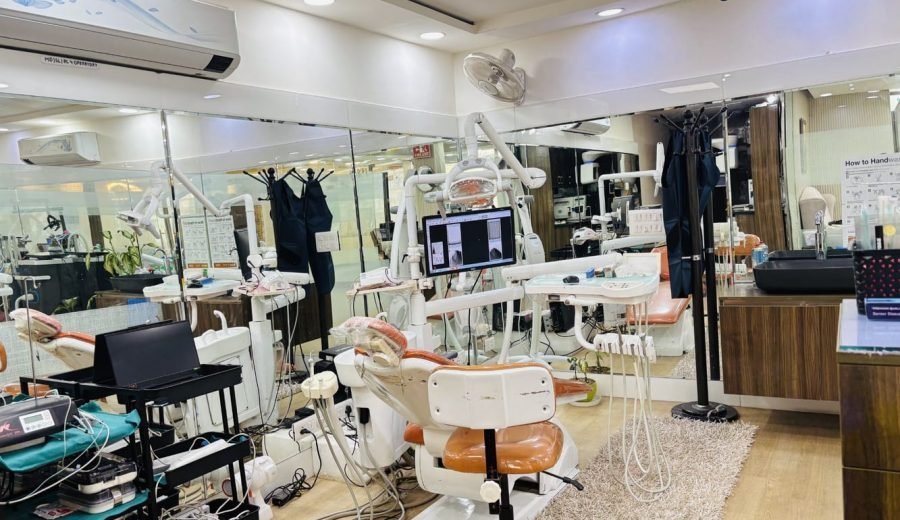
✅ Real clinic photo — already in Media Library (geo-tag with clinic coordinates on upload).
Some patients are told their jaw bone is “weak” or “soft” even when there appears to be enough bone on an X-ray. This is not a misdiagnosis — it is a different problem from a shrunken jaw, and one that is often misunderstood. Bone quantity can look adequate while bone quality is poor: spongy, low-density bone that does not grip an implant the way dense bone does. This dentist-reviewed guide explains what jaw bone implants in weak or soft bone actually require, the Misch density classification used to grade bone quality, and how surgical technique is adapted for weak bone tooth replacement at Muskaan Dentals.
Why Bone Quality Matters as Much as Quantity
Implant success depends on two qualities of the supporting bone: how much there is, and how dense it is. A standard X-ray shows the first but not the second. The implant has to grip the surrounding bone tightly during the healing weeks while new bone fuses around it (osseointegration). In dense cortical bone (like the lower front jaw), an implant locks in firmly the moment it is placed — strong primary stability. In soft spongy bone (typical of the upper back jaw, or in some patients generally), the same implant feels looser at placement and is at higher risk of early failure unless the technique is adapted. This is why some patients with apparently adequate bone still hear that their case is “risky” — the issue is quality, not quantity.
How Is Bone Quality Graded?
The Misch classification (the standard implantology grading system) ranges from D1 (very dense) to D4 (very soft). Where you sit on this scale decides how the implant is placed.
D1
Very dense cortical
Typical of lower front jaw. Best primary stability. Standard protocols work without modification.
D2
Dense with spongy core
Considered ideal for implants. Excellent primary stability, good blood supply for healing.
D3
Thin cortical, spongy core
Common in upper jaw. Needs undersized drilling and longer healing. The most frequent weak-bone scenario.
D4
Very soft, low-density
Specialist case. Aggressive-thread implants, bone condensing, extended healing. Sometimes basal implants are a better fit.
Illustration to add — AI-generated
| 📐 SIZE | 780 × 520 px (WebP, max 150KB) |
| 🏷️ FILE | misch-bone-density-classification-illustration.webp |
| 🔤 ALT | Cross-section illustration of the Misch bone density classification D1 to D4 showing dense cortical bone progressing to soft low-density bone |
🎨 AI IMAGE PROMPT:
Clean medical infographic on a soft off-white background showing four side-by-side cross-section diagrams of jawbone density grades according to the Misch classification: D1 (very dense, solid white cortical bone), D2 (dense with thin spongy core, mostly solid with small honeycomb texture), D3 (thin cortical with larger spongy core, more honeycomb visible), D4 (very thin cortical with predominantly spongy low-density core, mostly honeycomb pattern). Each diagram labelled with the grade and a short descriptor. Below the four diagrams, a small horizontal scale bar showing 'DENSE → SOFT' with arrows. Navy #1a1a2e and red #c0392b accents, green for D1/D2 and amber/red for D3/D4. No baked-in paragraph text beyond short grade labels. Professional dental-clinical aesthetic, flat vector cross-section style.
Clean medical infographic on a soft off-white background showing four side-by-side cross-section diagrams of jawbone density grades according to the Misch classification: D1 (very dense, solid white cortical bone), D2 (dense with thin spongy core, mostly solid with small honeycomb texture), D3 (thin cortical with larger spongy core, more honeycomb visible), D4 (very thin cortical with predominantly spongy low-density core, mostly honeycomb pattern). Each diagram labelled with the grade and a short descriptor. Below the four diagrams, a small horizontal scale bar showing 'DENSE → SOFT' with arrows. Navy #1a1a2e and red #c0392b accents, green for D1/D2 and amber/red for D3/D4. No baked-in paragraph text beyond short grade labels. Professional dental-clinical aesthetic, flat vector cross-section style.
How Is a Bone Deficiency Implant Case in Weak Bone Adapted?
Standard implant protocols are designed for D2 bone. For weaker D3–D4 bone, five adaptations are routine at Muskaan Dentals: (1) Undersized osteotomy — the drilling is deliberately narrower than the implant, so as the implant goes in it compresses and densifies the surrounding bone, improving grip. (2) Bone condensing osteotomes instead of cutting drills, which preserve and compact rather than remove the existing bone. (3) Aggressive thread design — implants with deeper, sharper threads grip soft bone better than smooth-walled implants. (4) Extended healing — 4–6 months before loading, instead of the standard 3–4 months, to allow weaker bone to fully integrate. (5) No immediate loading — unless excellent primary stability is confirmed at placement, we avoid loading the implant early. Honesty over speed protects long-term success.
With these adaptations, long-term success rates in soft bone reach 90–95% — only slightly below the 95–98% range for dense bone, and far higher than what is achievable with unadapted standard protocols. Dr. Suresh Ahlawat (BDS, MDS, DNB USA) has placed implants in many weak-bone cases over 35+ years; international training in advanced soft-bone protocols (France, Korea, Europe, China, Bangkok) underpins the approach. All four Muskaan Dentals branches in Gurgaon hold NABH accreditation, and every case begins with a CBCT scan that measures both your bone quantity and your bone density, plus a written treatment plan tailored to your specific Misch grade.
Medically reviewed by Dr. Suresh Ahlawat, BDS, MDS, DNB USA — Chief Implantologist, Muskaan Dentals, Gurgaon. This article is for general information and does not replace a clinical consultation.
Frequently Asked Questions
Implants for weak jaw bone in Gurgaon — your common questions answered.
What does “weak jaw bone” actually mean?
Weak jaw bone is a patient-friendly term for what implantologists call low-density or soft bone. The volume of bone may look adequate on a regular X-ray, but the bone itself is spongy rather than dense — less able to grip and hold an implant securely during the critical healing phase. This is a different problem from having too little bone (quantity) and needs different management. The Misch classification grades jawbone density from D1 (very dense cortical) to D4 (very soft, low-density) — most weak-bone cases fall into D3 or D4.
How is jaw bone quality measured?
A CBCT 3D scan is the standard tool. Unlike a regular dental X-ray, a CBCT shows not just bone shape but bone density at every potential implant site, measured in Hounsfield units. Dense cortical bone (typical of the lower front jaw) shows high values; soft cancellous bone (typical of the upper back jaw) shows much lower values. The scan, combined with what is felt during the implant drilling itself, gives a complete picture of bone quality and allows the surgical approach to be tailored before any implant is placed.
Can implants still work in weak or soft jaw bone?
Yes — the success rate is slightly lower than in dense bone, but it is still high when the surgical technique is adapted. Modern protocols for D3–D4 bone include undersizing the drilling (so the implant grips tightly even in softer bone), choosing implants with aggressive thread designs that improve initial stability, allowing longer healing time before loading (often 4–6 months instead of 3–4), and avoiding immediate-load protocols until integration is confirmed. With these adaptations, long-term success rates in soft bone reach 90–95%.
Is a bone deficiency implant case different from a low bone density case?
Yes — and the distinction matters. “Bone deficiency” usually refers to insufficient bone quantity (the ridge has shrunk and there is too little bone overall). “Weak bone” or “low density” refers to insufficient bone quality (there is enough bone by volume, but it is soft and spongy). The two problems can occur together or separately. A CBCT scan tells which you have. The treatment plan, surgical timing, and implant choice differ for each — a one-size-fits-all approach is what causes avoidable failures.
What surgical techniques work best for weak bone tooth replacement?
Five adaptations are routinely used at Muskaan Dentals for weak or soft bone. First, undersized osteotomy — the drilling is intentionally narrower than the implant so the implant compresses and densifies the bone as it goes in. Second, osteotome bone condensing rather than cutting, which preserves and compacts the existing bone. Third, choosing implants with deep, aggressive thread patterns designed for soft bone. Fourth, extending the healing time before fitting the final crown. Fifth, avoiding immediate loading unless excellent primary stability is achieved at placement — honesty over speed.
Where can I get jaw bone implants tailored to weak bone in Gurgaon?
Muskaan Dentals offers soft-bone-adapted implant care across four NABH-accredited branches in Gurgaon — Sector 43 (Sushant Lok), Sector 56, Sector 14, and Sector 52 (Ardee City). All weak-bone cases are personally overseen by Dr. Suresh Ahlawat (BDS, MDS, DNB USA, 35+ years) with international training in soft-bone protocols. The first consultation is free and includes a CBCT scan that measures both your bone quantity and your bone density (Hounsfield units), with a written treatment plan that specifies the implant brand, technique, and timeline tailored to your specific bone quality.
Soft Bone? It's Manageable With the Right Technique.
Book a Free CBCT Density Assessment in Gurgaon
A CBCT 3D scan measuring both bone quantity and bone density (Hounsfield units), an honest assessment of your Misch grade, and a written treatment plan with the adapted protocol for your specific case.
4 NABH branches across Gurgaon · Mon–Sat 10 AM–7 PM · Sunday 11 AM–1 PM
Dr. Suresh Ahlawat · BDS, MDS, DNB USA · 35+ years · NABH · 4.8★ · 1,900+ Reviews
Our Initiatives



For any Queries or assistance please call: +91-94-94-94-7304
MUSKAAN Dentals is 1st NABH ACCREDITED Chain of Speciality dental centers headed by Dr. Suresh Ahlawat BDS, MDS, DNB (USA) having more than 30 Years of National & International experience, Dr. Ahlawat is a Maxillofacial Surgeon Specially trained in Dental Implants in France, Korea, Europe, China and Bangkok etc in various implant systems.
Treatments
Dental Implants
Dental Crowns
Root Canal Treatment
Dental Bridges
Root Canal
Full Mouth Rehabilitation
Clear Aligners
Laser Dentistry
Pediatric Dentistry
Contacts
Address
C-1039, Near Vyapar Kendra, Sushant Lok Phase - 1, Gurgaon, Haryana - 122009
© 2026 Muskaan Dentals Global | All Right Reserved.
Digital Partner: CODEMOTTO